So winter in Nevers is not an inspiring time. If the Burgundy region is known to be quite pleuvieux (rainy), occasionally, there can be winter when all of this precipitation turns into neige (snow). This winter was the coldest, snowiest winter in recent history for la Nièvre. Charming?
Well, the french have no system in place to respond to les intempéries (inclimate weather) in general, but especially when it comes to the schools. As all of France, and indeed Europe, was experiencing the same phenomenon, one result of all the snow was une manque de sel (a lack of salt) that came about almost immediately after the first bit of snow of the year. Unfortunately for the french, it kept snowing. So de-icing the roads by salting them became quite difficult, if not impossible. Fine, we cancel school in this case, right? You know, take some snow days and add them back at the end of the year. That way no one gets lost in the snow, no one risks car accidents, and those families that decide to be cautious do not see their children suffer academically. Apparently this is a very American idea. My teachers explained to me that, in France, school is seen as one of the state's obligations to its people. Alright, it is in the US too, right? Well, in France it's considered une obligation sociale (a social obligation), that is, it's more important that the school be open for children to have a place to go than it is for the learning conditions to be good and favorable. So no matter what happens with the weather, the school has to be open. So great, no confusion! Au contraire (On the contrary), it's much more confusing than if school were just to be canceled by the district. Each teacher has to determine if he or she can make it safely to school. After that, each teacher then decides if there are enough students present to continue with normal lesson plans. As for the language assistant, his or her role is considered minor enough that there's no need to le prévenir (let him or her know ahead of time). I would show up at school after walking through the snow and slippery ice, only to find out that there was no teacher or no students. How many days did we miss in January because of snow? I heard one teacher say 19, but there's actually no way to count.
Of course, this led even more teachers to râler (complain) about their students. The younger teachers, who tend to be less negative-- I'd put this positively if it seemed appropriate-- began to recall this snowstorm from 20 years ago. They reminisced about coming to school in the snow, seeing their friends, and walking long distances. They missed the hilarity, how their stories smacked of that typical elderly man who idealizes his childhood and critiques the youth of today. To their credit, however, the teachers did make a big effort to come. It's the ones who live out in the country and have to drive on back roads who simply couldn't add anything to the pity party for fear that they would make everyone else feel uncomfortable when they realized their situation wasn't too bad. When I told the teachers I thought it was outrageous that there would be no way to ratrapper (recuperate) the lost days, however, they did not think to complain about the fault in this system.
I read in The Washington Post just the other day an article about snow days in a Maryland high school with an IB program. On such days, teachers asked students to continue forward with assignments and post responses to questions on a class wiki. There were discussion boards so that students and their teacher could continue to work through ideas without even being present. While students' reactions to the system were somewhat mixed, including the comments about keeping on track from wise, responsible students and complaints about the lack of contact from more hyperactive, ultra-motivated students, the majority opinion was that in order to stay competitive and keep expectations high, the school had a certain obligation to use technology to their advantage. Those students know their exam won't be moved, since a disinterested international advisory board regulates it, and they do not want to miss out on one subject just because the buses weren't running. I printed the article and cut it down to a manageable size for my students, but I'm not sure if I'm going to work on it with them. There might be simply too much cultural noise qui les empêcherait à comprendre (that would keep them from understanding).
So, vivement le printemps (hooray for spring). It's coming soon, and maybe it'll be more inspirational, and not of complaints, but of hope and beauty.
Thursday, February 25, 2010

Sunday, December 13, 2009
l'Entrée de la Ville


One of the most vivid way to understand the history of Nevers is by studying architecture and monuments. Nevers is a city that (barring the Roman era, from which we have only archeological remains and not architectural ones) was constructed in more or less three waves: the first, in the middle ages-renaissance with the Palais Ducal and Cathedral, the second, in the second half of the nineteenth century with Hausman-style bourgeois immeubles (apartment buildings), and the third, beginning after the second world war with more suburban-style individual houses. The contrasts between the architectural styles of these periods is quite stark, especially, once one is aware of them. The division between the quartiers (neighborhoods) is nette (neat, clear, distinct), and it's easy to tell when you're passing from one to the next.
The river traverses, and thus joins, the three kinds of quartiers. In Nevers, two ponts (bridges) represent the two more recent eras of development, the romantic period and the contemporary period. For what remains of the medieval period, however, one se demande (asks oneself) how people arrived in the town. Well, one of the tourist landmarks is the Porte de Croux (literally the door of Croux-- I still haven't been able to figure out exactly what this means). This "door" is a kind of entryway to the city with an arch. The tourist plaque in front of it explains that it was a symbol of welcome to the city. Of course, the plaque goes on to say that it was equipped with all of the latest defense mechanisms for the time period, including towers, arrow holes, and speared gates. The Porte de Croux is a complex of two arches, which, during the medieval period were separated by a moat, as far as I can understand from drawings I've seen. The first arch was meant to protect against military advancements such as boulets de fonte (melting cannonballs, what I imagine to be made out of still hot iron).
While the presence of these arches doesn't explain the problem of how to ford the river during the medieval period, it does serve to mark the beginning of the medieval quartier. Once you pass through, or next to, la Porte de Croux, you have no question as to where you are. Inside the ruins of the old remparts (ramparts, or city walls), you feel the 600 year-old history of the neighborhood, which, on by means of its slopped streets, leads to the top of the butte (hilltop) where the Cathédrale and Palais ducal dominate.
A walk along the remparts down to the river never fails to take me out of my present time, worries, and projects, even if only for the short instance it takes to notice the curious and perpetual shade of grey that colors the low-hanging sky and its ever-present clouds. The other day, while walking this route, I decided to read the little tourist placards I just mentioned. While glancing over them, I made a very happy discovery: the drawing of the two arches during the medieval period is accredited to one Charles Bossu! Recognize the name? It's the man after whom my street is named! I now have a stronger affinity for Général Bossu, and aspire to, like him, one day have a sketch of mine grace a tourist plaque, ensuring me a long legacy and eternal renown. I also am feeling more and more attached to this peculiar netherworld with its doom and gloom. Although I'm leaving tomorrow for a trip to the states, I'll be looking forward, in some inexplicable way, to retrouver (go back to) this dreamworld.
Tuesday, December 8, 2009
Biscuits dans la poche
I have to admit that, for me, the arrival of l'hiver (winter) in Never has not been tout à fait appréciée (exactly appreciated). It's not that it's particularly froid (cold), but it does rain a lot here, and it's always gris et nuageux (grey and cloudy). That said, while the weather and the fact that I didn't know many people kept me from going out at night for a while, I'm now perfectly used to it, and a stroll at any time of day is always le bienvenue (welcome). After having had la grippe (the flu) and being scolded for wearing petite chaussures ("little shoes"- mostly ballerina flats), ça y est (there it is), I'm wearing boots, thick scarves, and warm jackets. I've learned to cover up and am now in the habit of doing it. And, if it's raining, which it often is, I'm not too proud to take the bus on occasion, granted that I have 1.10 euros to spare.
So a week ago at church choir practice, I was feeling particularly sociable, wanting to combat l'arrivée d'hiver (the arrival of winter) by giving back in some way to the community that had welcomed me. When Collette, the woman who was sitting next to me at rehearsal, thought that I didn't know "Angles We Have Heard on High," I accepted graciously her singing directly into my ear. Then, when she was asking if anyone in the group could help her watch a video using her DVD player that myseteriously wasn't putting an image on her TV screen, I immediately offered to help. I thought that I've spent maybe too much time wondering what Nevers could offer me and not enough time thinking about what I could offer to Nevers. Besides, when the cold and darkness come with winter, it is certainly the time to tendre la main aux autres (extend your hand to others, or help them out). I agreed to come over to Collette's house after my classes on Tuesday afternoon, and she said she would be around, that she wasn't going out at all. I wrote down her address and promised to see her the following day to solve her technical problem, laughing to myself since I know that I'm not the best technical engineer the world has ever seen.
The following day, it was cold and rainy, as could be expected a Tuesday in December in Nevers. I had class later than I thought, so I left the lycée (high school) at 4pm, headed for centre ville. I wasn't sure where Collette's house was, so I stopped at one of the large city maps that are posted on the sidewalk downtown and reached for the paper on which I had written her address. Mince!(Darn!) J'avais oublié le papier chez moi- c'est pas vrai ! (I had forgotten the paper at my house- that can't be true!) I scanned the neighborhood where I knew Collette lived, and managed to find her street thanks to memory recall, and I headed in her direction. I had to consult another map along the way to make sure I was sure to end up in the right place-- the area was quite nice and mostly populated not with private residences but with cabinets de médecin et d'avocat (doctors' and lawyers' offices). But, before I knew it, I had found 3, rue de l'évêché, and sonnais à la porte (was ringing the doorbell).
Colette opened the door, m'a fait la bise (gave me two air kisses, the standard and warm greeting for friends). She invited me in, out of the cold, and introduced me Marie-Josèphe, who was helping her pay some bills, or clean the house, or some other little household chore. Then, suddenly, the real culture jolt began. Nevermind the bourgeois neighborhood, the well-kept house entirely decorated in beautiful antiques, or the bises for greeting, the old-lady assessment of a young woman is something typically french. As a foreigner in this country, I have an adoptive mother in every woman I meet. Really. These women couldn't resist commenting on how pretty I was, but that my pretty outfit lacked some warmth. I pointed out my boots, socks, tights, double skirt, wool sweater and scarf, which had been topped with a hooded coat, a hat, and a pair of gloves, but they said that I was practically nude and ready to catch cold if I went outside even two minutes dressed the way I was. They of course then wanted to know my life story and listened in awe as I spoke of Florida and university in America. Marie-Josèphe was particularly astounded by my ability to speak french. She herself had never succeeded in gaining knowledge in any foreign languages.
For these ladies, everything was a cause for concern regarding my health. They asked if I could help play the DVD they wanted to watch, and when I successfully switched the TV to the auxillary channel, they called my douée (gifted). They were sure that I was a bit mentally perturbed by all of the knowledge I had. Once the DVD, a recording of a nationally televised mass filmed in Nevers this summer, was playing, it was time to s'installer (settle in) and discuter (converse). Collette offered me something to drink. I asked if she had any tea, which sent her eyes directly in search of the clock. It was 5 pm. "At this late hour? You won't be able to sleep!" I told her I didn't think it was too late, and Marie-Josèphe ironically took my side, saying, "In any case, she's young, she doesn't sleep at all." So, although Collette would rather have served me an alcoholic apératif, I got a hot cup of tea. Well, a cup of hot water and my choice of about 10 varieties of tea. While waiting for the tea to cool down, Collette put herself to work being a host. She went to search me some cookies, even though I told her I wasn't hungry and that I had even eaten a little dessert with lunch. She would have none of my protestations, though, insisting, "Oui, d'accord, mais le dessert est déjà loin !" ("Yes, ok, but dessert was already a long time ago!"). She took out a box of cookies and I timidly put one on my saucer. I really didn't feel like having one.
As we chatted, Collette finished her tea and realized I still had some left. There was some debate as to whether or not we should make more tea, and then Collette realized that maybe I had somewhere to be, and that it was starting to get late. She asked how I was going to go home, and I assured her that I'd be taking the bus, knowing full well in my head that I preferred to take the 20-25 minute walk home. She watched as I bundled back up, and she worried about whether it was raining or if it were too dark outside. I assured her I'd be fine. Then we exchanged numbers, just in case, and I was ready to go. Or almost. Collette offered me some cookies to take with me, "pour casser la croûte" (to break the crust, or to whet one's appetite), as Marie-Josèphe said. I declined, saying that I would really be fine, but Collette insisted. She took a napkin, unfolded it, put a few cookies inside, wrapped them carefully, and tucked the little packet (package) directly in the pocket of my jacket. She then gave me la bise again and showed me to the door, telling me to faire attention (be careful) and prendre soin de moi (take care of myself). I had spent a nice hour in her little house, where at one point I was pretty sure I was never going to arrive.
In walking towards my house, I decided to see if there were, par hasard (by chance), any buses coming soon. It was actually starting to get dark, and it still hadn't stopped drizzling. As I approached l'arrêt de bus (the bus stop), the bus I needed was pulling up, so I ran to hop on. I paid my 1.10 euros and found a seat near the back. As the bus pulled away, I felt the petit packet (little package) in my pocket. I took it out, unwrapped the cookies, and ate one. I was a bit hungry, too. I watched the rues mouillées (wet streets) warm and dry from the window of the bus and thought about taking care of myself. The world, at winter time, can be a difficult place, but les gens sont peuvent souvent être gentils (people can often be nice). It's important to take care of oneself, especially quand il fait froid et la pluie est à rentrer dedans (when it's cold and the rain gets everywhere. So as Nevers brings its winter gloom-- grey, cold, and rainy-- I will be thinking of Collette and taking care of others and myself. I think that those places where the environment is the least comfortable, the people have a bigger capacity for dealing with inconveniences. My way will be having tea with cookies when I need to get warm and making sure to lend a hand when I can be of use.
Grosses bises !
Monday, November 30, 2009
Jeu de mots: Nev'hair coiffure
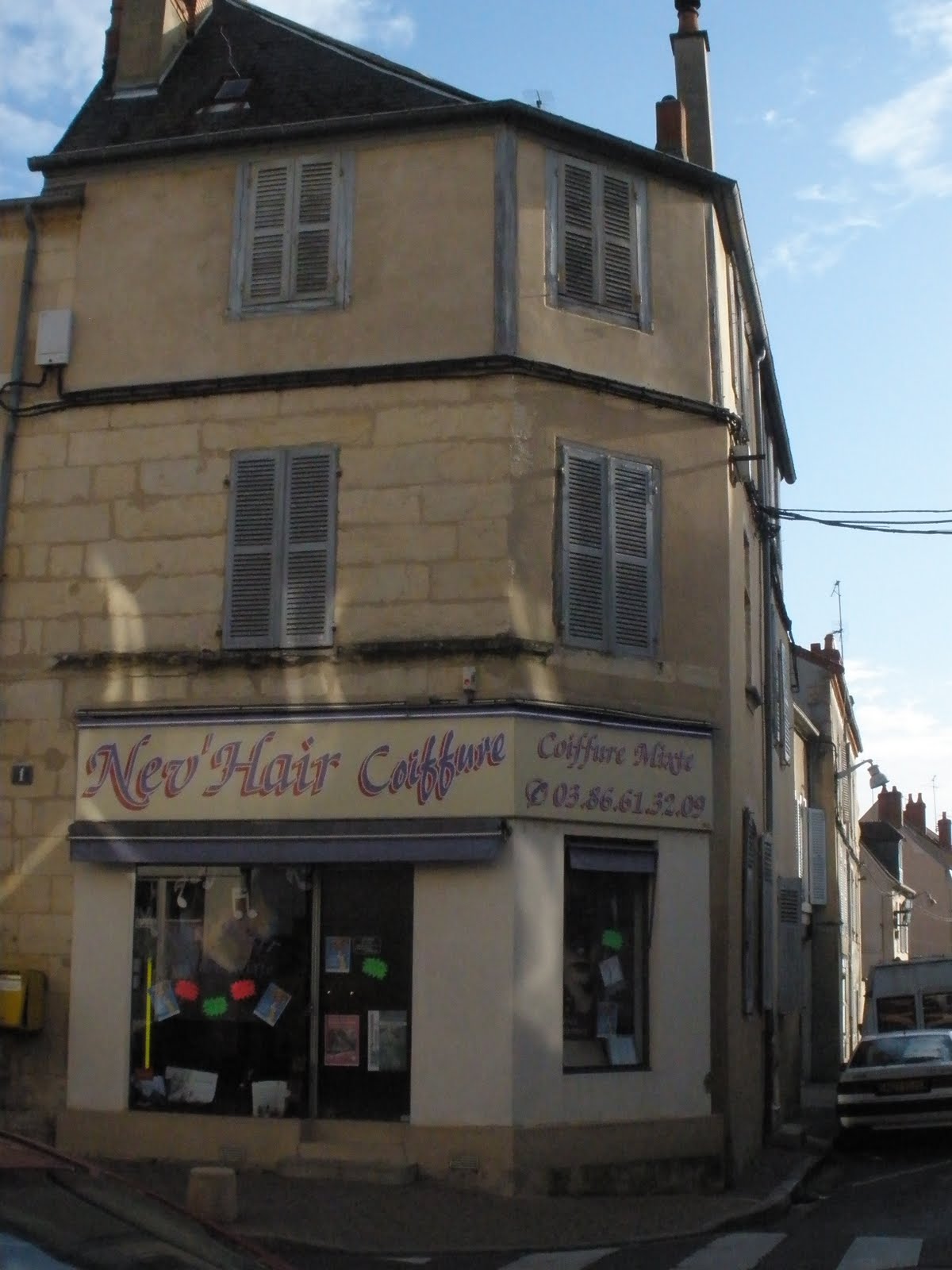
Okay, so I must confess I don't have much to say about this little aspect of the city. I was walking home one Saturday through the older part of town near St Etienne (pictures to follow), when I saw this sign. A combination of the French sensibility for puns, anglophilia, and general bad taste, I suppose. I have yet to passer chez le coiffeur (go to the hair salon) since I have arrived in Nevers, but something tells me I'll still be looking. Also, to appreciate the full humor, you must know that the french never pronounce the h as americans do, with un petit souffle d'air (with a little breath of air). Instead, they make a sharp, almost glottal attack of the succeeding vowel, so that the word "hair" effectively sounds like "ere". So enjoy, and more to come soon.
Gros bisous !
Wednesday, November 25, 2009
Ma Tasse de Thé


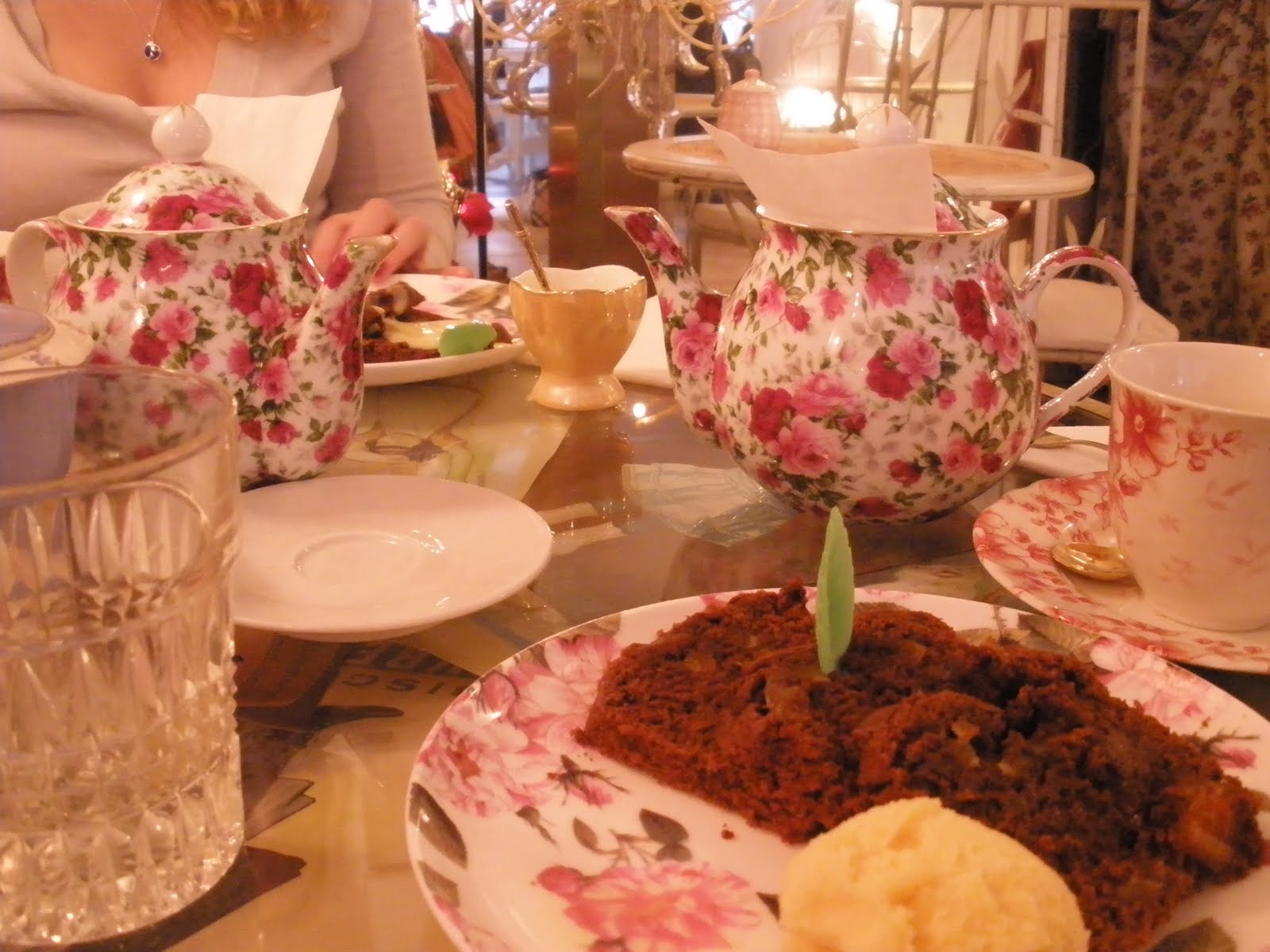
I'm not sure when I began to love tea. Certainly not when I was a child-- much like coffee, it was one of those very "adult" substances to which not nearly enough sugar could be added to make it drinkable. The bitterness of tea seemed a mysterious paradox to me. How could this liquid, which I associated with nice old ladies and frilly doilies, cut so directly to the deepest reaches of my tastebuds, triggering a reaction of such profound disgust? Whenever it was that I came to love tea (perhaps is was over the course of an adolescence spent drinking iced tea in the South?), present signs show no prospect of a withering of the flame of passion. A good cup of tea provides the strength to surmount any problems. Posing a challenge in itself, there's the restraint required to wait until the water no longer burns the tongue. Yet once the tea reaches a drinkable teaxture, the cooling process happens with a speed just as rapid, if not exponentially moreso. This means that after waiting patiently, one must precipitate-- gracefully, bien entendu (well understood)-- on one's cup so that one can drink the tea before it becomes icy. En outre (otherwise), the healing properties of the tea leaves themselves have been carefully observed by many cultures around the world.
Tea as a substance is of course an undeniably important part of human existance, and tea culture witnesses that. In Carlisle where I used to live, the recreational interest in colonial history had given rise to an antique-style tea parlor, Camelia's Sin, complete with oversized and outrageous hats that gave a nod to our postmodern American desire for anachronism. When I lived in Toulouse, Brititsh-style tea parlors abounded, as the French in general but Toulousains in particular had an obsession for British culture. At these parlors, instead of the full high-tea lunch that Camelia's Sin offered, there were never-ending tea menus and a short list of high-quality cakes to eat as an afternoon treat. Other towns I have visited have offered their own interpretation of tea culture, and many friends have shared their personal tea rituals with me.
In Nevers, I learned recently that tea plays into the role of high society dames bourgeoises (upper class ladies). The one American teacher at my lycée told me that in her husband's social circle, nice ladies didn't work, rather they sat around and drank tea while finishing their darning. Tea is, after all, a much more respectable boisson à consumer (drink to consume) than wine or Coke, of all things. This estimation explains the allure of the tea parlor in Nevers, called En Apar-thé. The tea parlor, which is juste à côté de (right next to) the Porte de Paris, the large arc that leads into the downtown from La Place de la Résistance, is decorated not necessarily in antiques, but certainly in overly-femenine bourgois-bohème (shabby chic) baubles. A large chanedelier hangs over a central table. Ecclectic chairs are grouped around many round groupings, creating an intimate, if not a bit crowded, atmosphere. The clientele is divided between a majority of elderly ladies and usually one table with a mother and daughter. It seems that the women who frequent the parlor have a high consideration for their appearance and are always well-dressed when visiting. Although I haven't seen any darning pulled out of sacs (bags or purses), it wouldn't really surprise me, and I'm sure that one of these winter afternoons I myself will have a knitting project in hand.
En Apar-thé has become somewhat of a destination for my friend Emma and me. We've been there maybe three times already, and the almost exhorbitant price of 3.50 for a pot of tea plus 4.20 for a slice of cake so far hasn't deterred us. I appreciate the salon's numerous green tea offerings, many of which have floral petals or fruit rinds mixed in. Emma's favorite is the Esprit de noël, with almond and spices, and which she has commandé (ordered) all three times we've been. Côté déssert (On the dessert side), En Apar-thé has a simple list of mostly classic french gâteaux (cakes), including mouelleux au chocolat, quatre quarts, and gâteau au noisettes. I've tried a few, and they're all delicious. Served on floral china with a tiny spoon or fork, they certainly invite dainty table manners, and polite conversation. That is, if the people in the parlor understand what you're saying...
All of this to say that on a rainy, grey afternoon in Nevers (where? really?), don't despair, stop in for a cup of tea and une bonne part de gâteau (a good serving of cake), et, bien sûr, de la discussion avec de bonnes copines (and, of course, good conversation with good (girl)friends).
Gros, gros bisous !
Tuesday, November 24, 2009
Endroit d'honneur: le Palais Ducal


The origins of the city that is now called Nevers are a bit mysterious, if only because a serious archeological investigation has yet to be accomplished in the region. Many people think that the contemporary city of Nevers is located on the site of a Roman town called Noviodunum Aeduorum, and another Roman called Neverinum provides an attractive historical trace. The names of both of these towns provide an obvious link with the contemporary names Nevers and la Nièvre, so the fact that some Roman ruins found in this general region of the Loire river tends to close the link. In any case, Nevers is a town with a rich Common Era history, to which the two symbols of power in the center of town-- the religious power of Cathedral and the temporal power of the Palais Ducal (Ducal Palace)-- give witness. Nevers has certainly known municipal difficulties in the last one hundred years. After the second world war, many neighborhoods were ravaged. Although the cathedral was repaired, it seems that even now there are buildings that suffered from attacks. Furthermore, in the last 50 years, suburban sprawl to the exterior of town has decreased the aesthetic value of the greater communal area. Yet all of that aside, in the second half of the second millenium of the Common Era, Nevers was quite a hub of activity, and the Ducal Palace was the headquaters of an industrious population.
The Palais Ducal distinguishes itself from the rest of the city by its remarkably clean and well-groomed appearance, which offsets even more its distinctive château-esque architecture. It sits at the edge of the central square, the Place Carnot and looks out over two large open spaces with a vista that extends to the Loire. In terms of building materials, the tan brick that composes the palais is also distinctive-- the rest of Nevers is fairly uniformly built of a pale stone or cement-covered stone, depending on the period of construction. Some fanatics for the city claim that the palais ducal in Nevers is the first of the famous "Châteaux de la Loire" the name given to the disparate group of renaissance-era private residences for various royal families that all inhabited the same river on which Nevers is set- La Loire. Although personally I find that appelation (naming) a bit prétentieux (pompous), it is a fancy private residence, the earliest part of whose construction dates to the 15th century. So château or not, it is on the Loire and it is the oldest one there. Also, as it is the only architecture in Nevers that is remotely noble, it dominates the city as a kind of de-facto château.
The Palais Ducal is the pride of Nevers, and the city honors it well. In 1840 it was named a Monument Historique and thus is part of the very first group of monuments preserved under France's highest classification of honor and government protection . Yet, as every part of the contemporary presentation of the palais proves, Nevers is far frompassively contented with its little monument and its sedentary history. For example, the current city blazon (insignia/crest) is a modern sketch of the recognizable towers from the palais. Furthermore, to the side of the palais is a modern tourist office with a small glass pyramid that recalls a renouvellement of a certain Parisian palace (Le Louvre and its pyramid, anyone?). And on the inside of this pyramid is an exhibit that presents the history of Nevers, from earliest times (those Roman remnants I mentioned at the beginning of the post) to the ducal era through to the contemporary period, in which Nevers is known for its Formula One race track (Magny Cours) and faïence (painted porcelin). Above all, since the restauration of the palais in the 1980s, the building is often used for official meetings and events in its many large conference and ball rooms.
If you're ever in Nevers, don't forget to visit the Palais Ducal. When I arrived in the city and was giving my first classes to my high schoolers, they mockingly said I should go visit the palais if I was looking for something to do. But it's true, it's a monument rich in a unique history. A forthcoming blog post will explain a bit more of the familial heritage and the multi-stage construction of the building. The principle families that ruled as the Dukes of Nevers were the Clamcey, Clèves, and Gonzaga, the last of which, you might imagine, had the most profound influence on the ultimately renaissance style of the southerly façade, the side that looks out onto the aforementioned places with the spectacular vista. Climbing the grand spiral staircases and looking out onto the city that shrinks into the landscape of river and hills, one understands and appreciates what it may have been like to mistreat and renounce the paysans et villageois (peasants and villagers). But I don't renounce you villageois, even if the places where we live are far and largely overpowered by the impressive natural barriers that separate us.
Plein de bisous, mes amours !
Monday, November 2, 2009
Le Conservatoire
When I lived in Toulouse, I had the amazing good fortune to take classes at the Conservatoire National de la Région de Toulouse (The National Conservatory of the Region of Toulouse). There, I took oboe lessons with two professors, one of whom had studied at the Paris Conservatory in the 1960s and had thus participated in or at least witnessed the french national school from très proche (up close). This professor, Monsieur Fussis, thus told me all about his experiences with Francis Poulenc as he was working on his Sonate pour hautbois et piano. The Conservatoire in Toulouse was lively, but certainly full of young musicians, mostly in middle and high school, who were considering the pursuit of careers as professional instrumentalists. They were at the age where, if they practiced enough, the musical talent that their teachers had identified when they were very young, could bear fruit in the professional realm. I thus played in a youth orchestra and waited for my lessons with a young high schooler- maybe he was in seconde (sophomore year)? I took my solfège (applied music theory) class with adults, but this was a bit rare, and as I never ran into my classmates at the Conservatoire, I got the distinct impression that there, musical practice revolved around the youth.
Music, Monsieur Fussis once explained to me, is considered by the french a métier (professional activity) much more than an art, so musical education in France is highly regulated. Musical instruction or activity of any kind is rare in a normal school and is for the most part relegated to the regional conservatories. These centers are operated by the state and their curriculum comes from the center of the nation, Paris, where directors decide on the exam pieces, repertory, and instructional methods. Each Conservatoire has its prizes, but the only ones that matter come from Paris. Thus, as students progress, they try their hardest to earn a spot at this renowned musical epicenter, sure that if they have their diploma from this school, they will find work. This means that although Paris is clearly in a distinctly priviledged position, it is not removed in an isolated elitist way. Paris is connected with the whole réseau (network) of Conservatoires, or more aptly, this réseau revolves around the capital. Students thus have the hope of moving to Paris one day if they have both the talent and the discipline to progress to a high level. The standards are high, but they are clear and fair-- in line with the French ideal of égalité (equality).
In Nevers, unlike in Toulouse, the musical activity radiates from an École Nationale de Musique (National School of Music). As far as I have been able to understand, this has the same legal and musical standards as a Conservatoire National except that an Êcole is found in the préfecture du département in contrast to a Conservatoire, which is located in the chef-lieu de la région. It's a bit complicated, sure, but the French love their hierarchies as a result of their extreme centralization. In any case, the Région where Nevers is located, la Bourgogne has its chef-lieu in Dijon. The Département, which is part of the région, is called la Nièvre, and Nevers is the préfecture. Think of Nevers as Gainesville, which is the county seat of Alachua County and Tallahassee as the capital of Florida. The administration works kind of like that. Since Nevers has no Conservatoire, the École Nationale de Musique is the best musical institution in the city and in the wide surrounding area. Here one finds all of the musical activity possible, including individual instruction, group practice, solfège studies: the works. And, since there is no official Conservatoire, when people refer to the school of music, everyone uses the word "conservatoire," to add imprecision to the otherwise orderly system.
As seems to be the case here in Nevers, the conservatoire's network touches many parts of the society. When I told Françoise that I sing and would like to continue studying voice if possible, she told me I needed to go see the director of the conservatoire, whom she knows personally because her children studied music for many years. I went to the conservatoire on my second day in Nevers, introduced myself to the directrice, mentioned Françoise's name, and left my number so I could be contacted when the chorale (large chorus) started its repertory for the fall/winter season. I later learned that a few of the teachers at my lycée sing at the conservatoire, including one of the English teachers, Catherine Lebrun, who volunteered to drive me to the rehearsals, since they begin at 8:30pm on Thursday nights. The rehearsals for the chorale began earlier than expected, and before I knew it, I was being whisked off into the Thursday evening darkness week after week to sing avec les potes (with friends, as they say in the Burgundy region). In all, there are two lycée teachers in the chorale, but I haven't noticed any of my students there. The people there are certainly friendly, and there is always lots of lively discussion as the members arrive for each rehearsal.
One contrast between this École and the Conservatoire in Toulouse: the average age of the people I see there. The chorale is above all an adult group. There are maybe four or five twentysomethings in the group other than myself, and the next age group begins at the cinquantaine (the fifty-year mark). Cela ne me dérange pas (that doesn't bother me), but it certainly is a change of pace to be surrounded by baby boomers and not their children. As I was discussing with Sarah, a french student of musicology and musical pedogogy who sings in the chorale, the frustrating part about the age group is that the adults, paradoxically enough, don't seem to learn their music very quickly. Compared to children, they have lost the habit of adapting to and assimilating new information all the time. The chef de choeur (choir director) usually makes us repeat a stylistic adjustment about five times before everyone in the group has made the change, and even then... enfin (oh well). The group of adults is quite mixed in terms of musical knowledge and voice training, and while a majority has a strong hold of musical expression and the use of the voice, certain hae pronounced difficulty in the sensitivity of the musical phrase. It is great for the community that the Conservatoire offers such a group practice, but I am still mystified that there aren't more young people in the group.
Sarah and I were chatting the other day about musical practice in France, and although the system seems much more strightforward to navigate than the American system, the musical profession is still extremely difficult to penetrate. Contemporary society seems not to have a need for many professional instrumentalists, alors (so) the spaces in musical schools are limited. Sarah realized after years of piano and cello lessons that she would never be a professional, so she attempted a medical degree. After one year of medical school, she had had enough and knew that she had to follow her musical passion. She went to the director of the conservatoire in Nevers to ask what course of study she could follow, and she decided upon teaching: solfège, piano, and directing choirs. She has many years of studies ahead of her, but I think the Conservatory system will help her arrive at her goal. In any case, I'm glad she's there, because she seems to be someone who is in a similar position to mine, and she is helping me understand a lot about the group dynamics in the chorale and in the classe de chant (voice class with both individual and group instruction), which makes the whole experience much richer for me. Le Conservatoire n'est pas que les vieux ! (The Conservatory isn't only for the old people!)
I'll be sure to write more about the cours de chant soon, especially once I understand a bit more about how my voice teacher, a Bulgarian, found her way to Nevers, and what her students have gone on to accomplish. There's a week of activities around a Bulgarian composer, Isabelle Alboulker, that involves many parts of the Conservatory, and that should create some activity in the city as well. But for now, I think it would be good to go sing in a practice room!
A bientôt,
Megan
Subscribe to:
Posts (Atom)